
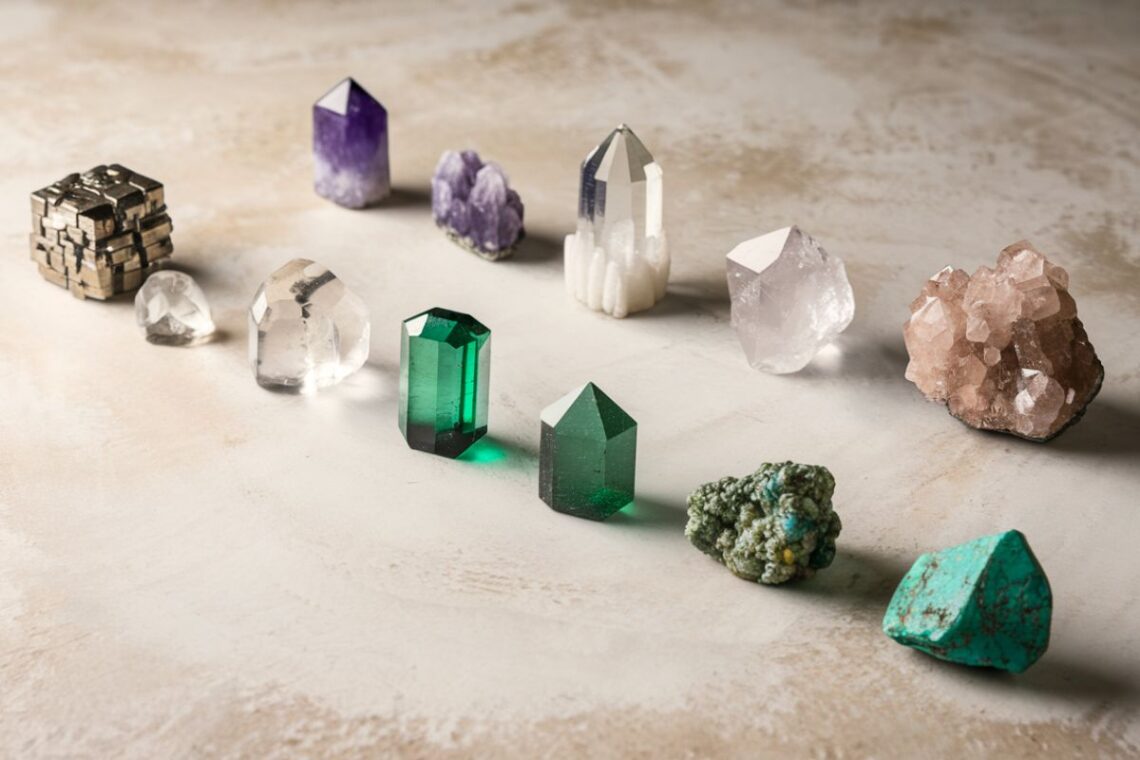
Crystals have long been valued for their unique structures, colors, and healing properties. However, identifying crystal types can be challenging, especially for beginners. Whether you’re a collector, a healer, or just starting to explore the world of crystals, understanding how to identify them is essential for choosing stones that align with your intentions.
Crystal Identification: Recognizing & Differentiating Crystal Types
Identifying crystals combines art and science, requiring an understanding of their unique visual, structural, and energetic traits. Let’s explore foundational methods for crystal identification, including observing structural details, color, luster, and inclusions.
1. Understanding Crystal Structure & Formation

Every crystal’s identity begins with its atomic structure and formation process. Crystals form under specific geological conditions, shaping their symmetry, facet arrangement, and overall structure. Familiarizing yourself with crystal systems—such as cubic, hexagonal, and triclinic—provides insights into their distinct forms and helps lay the groundwork for effective crystal identification.
Research supports this, as Raman spectroscopy can analyze structural markers to reliably differentiate types underscoring the importance of crystal systems in accurate identification (Aligholi et al., 2015).
| Crystal System | Description | Example Crystals | Characteristics |
|---|---|---|---|
| Cubic | Square or rectangular symmetry, forming cubes or octahedrons. | Pyrite, Garnet | Strong symmetry, cube-like shapes. |
| Hexagonal | Six-sided symmetry, often prismatic. | Quartz, Emerald | Prismatic, six-sided structures. |
| Trigonal | Three-fold symmetry, elongated or triangular shapes. | Calcite, Tourmaline | Triangular, columnar forms. |
| Tetragonal | Four-sided symmetry, rectangular cross-sections. | Zircon, Wulfenite | Rectangular shapes with varying ratios. |
| Orthorhombic | Rectangular base, tabular or columnar shapes. | Topaz, Peridot | Rectangular, with right angles. |
| Monoclinic | Inclined angles, irregular shapes. | Gypsum, Moonstone | Slanted, asymmetrical structures. |
| Triclinic | Least symmetrical, highly irregular forms. | Kyanite, Turquoise | Asymmetrical, rough shapes. |
2. Observing Color & Transparency
Color is a key starting point for identifying crystals, though variations and impurities can sometimes obscure true hues. For example, amethyst and fluorite may both appear purple, but amethyst typically has a more uniform tone, while fluorite often exhibits multicolored banding. Pairing color with clarity—whether a stone is transparent, translucent, or opaque—provides further insights to distinguish between similar-looking crystals.
- Quartz Family: Known for a broad spectrum of colors—clear (clear quartz), purple (amethyst), pink (rose quartz), and brown (smoky quartz).
- Green Stones: Green hues are commonly found in crystals such as malachite, jade, and green aventurine.
Studies confirm that trace elements, such as iron in amethyst, influence color, highlighting how a combined observation of color and clarity can reliably support crystal identification (Kitawaki, 2011).
3. Examining Hardness (Mohs Scale)
The Mohs hardness scale ranks minerals by scratch resistance, from 1 (soft) to 10 (hard), offering a practical approach to identifying crystals. Using common items like a fingernail (2.5), copper penny (3), or steel nail (5), you can test a crystal’s hardness to aid identification.
- Fingernail Test: Soft crystals like selenite (Mohs 2) can be scratched with a fingernail, while harder crystals like quartz (Mohs 7) resist this.
- Steel and Glass Test: Crystals with hardness over 5.5 can scratch steel or glass, distinguishing quartz from softer stones.
Hardness testing is a trusted method in mineralogy and gemology for its effectiveness in differentiating similar stones, making it an invaluable tool for field identification.
4. Analyzing Luster & Surface Reflection
Luster, the way a crystal reflects light, is a key identifier, ranging from glassy to metallic to silky. Lightly rub the crystal and examine how it reflects light to help identify it. For example, quartz has a glassy luster, pyrite appears metallic, and selenite exhibits a soft, silky sheen. Studies show that light interaction helps distinguish similar-looking crystals, such as different varieties of tourmaline, underscoring luster’s role in differentiating crystals by visual qualities (Pasetti et al., 2023).
- Vitreous Luster: Glass-like shine seen in crystals such as quartz and tourmaline.
- Metallic Luster: Seen in pyrite, galena, and other metals, giving a shiny, metallic appearance.
- Waxy or Dull Luster: Stones like turquoise and jade often have a softer sheen rather than a reflective surface.
5. Checking for Streak Color
The streak test, performed by rubbing a crystal on unglazed porcelain, reveals the “true color” of its streak, which can differ from the outward appearance and serve as a reliable identification marker.
The streak test is a widely accepted technique in mineralogy and gemology, especially effective for identifying minerals with metallic lusters. It’s a straightforward, practical method to confirm a crystal’s identity based on the unique streak color it leaves.
- Example: Hematite’s reddish-brown streak contrasts with its silvery exterior.
- Testing Tip: Use a streak plate or the unglazed base of a porcelain mug for quick results.
6. Recognizing Common Inclusions & Patterns

Inclusions—tiny particles or features within a crystal—provide valuable hints about its type and origin. Certain crystals are known for distinct inclusions; for example, rutilated quartz displays needle-like formations of rutile, while garden quartz (lodolite) often has mossy inclusions that mimic natural landscapes.
- Rutile Needles: Found in rutilated quartz, these appear as golden or reddish needle-like inclusions.
- Moss Patterns: Moss agate often features green, moss-like inclusions, giving it a unique appearance.
- Rainbows and Phantoms: Quartz may contain trapped gas or minerals that create colorful rainbows or ghostly “phantoms” representing earlier growth stages.
Research by Munuswamy et al. (2017) confirms that specific inclusions are unique to certain crystal types, making them a reliable factor for accurate identification.
Inspection Tip: Use a magnifying glass to examine inclusions closely, enhancing clarity for more precise identification.
7. Using Light to Identify Translucency & Opacity
Some crystals allow light to pass through them (translucent), while others are completely opaque. Observing translucency versus opacity can be a simple yet revealing step in crystal identification. For example, rose quartz is often semi-translucent, while rhodonite is opaque.
Studies show that light transmission properties are connected to a crystal’s internal structure, confirming that translucency observations are an effective first step in distinguishing between certain types of stones.
- Example: Rose quartz allows some light to pass through, unlike opaque pink rhodonite.
- Lighting Tip: Hold your crystal up to natural light to assess its translucency or opacity.
8. Understanding Fluorescence Under UV Light
Under ultraviolet (UV) light, some crystals exhibit fluorescence, glowing in unique colors that aid in their identification. For instance, fluorite glows blue or green under UV light, while calcite may fluoresce pink or orange. This property provides a distinctive way to narrow down crystal types.
Studies validate UV light testing as a reliable method for distinguishing crystals, particularly in differentiating similar types like calcite and fluorite (Viry et al., 2018).
- Example: Fluorite fluoresces green or blue, while calcite may glow pink.
- UV Testing Tip: Use a handheld UV flashlight in a dark room to observe fluorescence for certain crystals.
9. Using Digital Identification Tools & Resources
Digital tools, including apps, provide convenient access to crystal identification by analyzing images and offering properties and origin details. While these tools are helpful, they work best as a supplement to physical testing.
- Example Apps: Rock Identifier uses photos for identification, while Gemstone ID offers properties of various gemstones.
- Usage Tip: Use digital apps alongside hands-on testing for more accurate results.
10. Developing a Hands-On Crystal Journal
Creating a journal with detailed notes on color, luster, hardness, and inclusions allows for continuous learning and provides a personalized reference for crystal identification. This method enhances familiarity with each crystal type over time.
- Example Entry: “Clear Quartz – Color: Transparent; Luster: Glassy; Hardness: 7; Inclusions: None visible.”
- Benefit: This approach not only builds your knowledge but also serves as a lasting reference guide for future identification efforts.
Crystal Identification Chart
| Crystal | Color(s) | Crystal Family | Typical Shape/Structure | Hardness (Mohs) | Luster | Special Properties | Uses |
|---|---|---|---|---|---|---|---|
| Quartz | Clear, pink, purple, smoky | Silicate | Hexagonal; six-sided prisms | 7 | Glassy | Common inclusions (rutilated, garden quartz), piezoelectric | Clarity, amplifying energy |
| Amethyst | Purple | Quartz family | Hexagonal; prismatic | 7 | Glassy | Fluoresces under UV light, color fades in sunlight | Intuition, calming, spiritual awareness |
| Fluorite | Green, purple, blue, yellow | Halide | Octahedral, cubic | 4 | Glassy | Fluoresces in UV light, color zoning | Focus, clarity, clearing negative energy |
| Citrine | Yellow to brownish orange | Quartz family | Hexagonal; prismatic | 7 | Glassy | Piezoelectric, fades in sunlight | Manifestation, positivity, abundance |
| Rose Quartz | Pink | Quartz family | Massive or prismatic | 7 | Glassy | Often cloudy or milky, rarely transparent | Love, compassion, emotional healing |
| Lapis Lazuli | Deep blue, often with pyrite | Silicate | Massive | 5-6 | Dull to waxy | Contains pyrite inclusions, deep blue with gold specks | Insight, wisdom, self-expression |
| Malachite | Green with banding | Carbonate | Massive; botryoidal | 3.5-4 | Silky to dull | Bands in concentric circles, toxic dust when unpolished | Transformation, protection, emotional clarity |
| Selenite | Colorless to white, clear | Gypsum | Monoclinic; tubular or fibrous | 2 | Pearly | Soft, can be scratched easily, can dissolve in water | Cleansing, mental clarity, spirit connection |
| Obsidian | Black, mahogany, snowflake | Mineraloid | Amorphous; glass-like | 5-5.5 | Vitreous | Volcanic glass, often contains inclusions (snowflake obsidian) | Protection, grounding, releasing negativity |
| Tiger’s Eye | Brown to golden yellow | Quartz family | Fibrous structure, hexagonal | 7 | Silky to glassy | Chatoyant effect (cat’s eye effect), fibrous structure | Confidence, courage, protection |
| Turquoise | Blue to green | Phosphate | Massive or nodular | 5-6 | Waxy to dull | Often found with brown or black veins | Communication, healing, emotional balance |
| Hematite | Silver-gray to black | Oxide | Massive or tabular | 5.5-6.5 | Metallic | Leaves a reddish-brown streak, heavy for its size | Grounding, stability, focus |
| Garnet | Red, green, black, brown | Silicate | Isometric; dodecahedral | 6.5-7.5 | Glassy | Often used as an abrasive due to its hardness | Passion, energy, physical strength |
| Jasper | Red, green, brown, yellow | Quartz family | Massive; usually opaque | 6.5-7 | Waxy to dull | Often has patterns like bands or spots | Stability, nurturing, grounding |
| Calcite | White, clear, yellow, orange | Carbonate | Rhombohedral | 3 | Glassy to pearly | Fluoresces under UV light, double refraction when clear | Emotional clarity, balancing, amplification |
Gaining Expertise in Crystal Identification
Mastering crystal identification takes practice and patience. Learning from experienced collectors, geologists, and mineralogists—through workshops, local clubs, or online forums—can offer invaluable insights. High-quality resources like field guides and mineralogy textbooks also provide essential knowledge, with detailed information, illustrations, and photos to strengthen your skills and foundation in crystal identification.



 English